
No products in the cart.
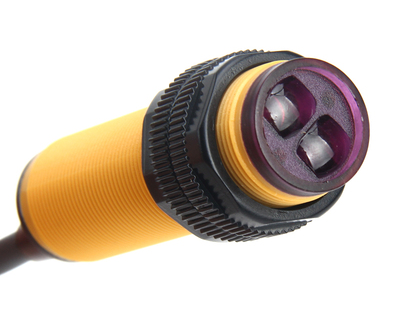
A photoelectric sensor is a non-contact device that uses a light emitter and a receiver to detect the presence, absence, distance, or orientation of an object .
Main Types of Photoelectric Sensors
- Through-Beam (Opposed): Features separate emitter and receiver units placed opposite each other. Interrupting the beam detects the object. It offers the longest range and highest reliability, but requires two mounting and wiring points.
- Retroreflective: Combines the emitter and receiver in a single housing and uses a separate reflector to bounce the light back. Breaking the beam detects the object. It needs only one-sided wiring and is more affordable, though less precise than through-beam models.
- Diffuse (Proximity-Sensing): Combines the emitter and receiver in a single housing and relies on light bouncing directly off the target object back to the sensor. It has the shortest range and is affected by the object’s color and texture, but is the easiest to install and most compact.
Key Features & Outputs
- Switching Modes: Can be set to Light-On (output turns on when light is received) or Dark-On (output turns on when light is blocked)
- Electrical Outputs: Functions as a photoelectric switch using PNP (positive-switching) or NPN (negative-switching) wiring to communicate with a PLC or controller.
- Common Applications: Used extensively in conveyor systems, material handling, packaging lines, and automated assembly.
Be the first to review “Photoelectric Sensor”
Related products

KSh3,600.00
KSh3,600.00

KSh2,500.00
Sensors
KSh10,500.00
KSh2,500.00
Reviews
There are no reviews yet.